Endarkenment by Arkadii Dragomoshchenko

ATD_EndarkenmentI am overjoyed that Arkadii Dragomoshchenko’s selected poems, Endarkenment, is now officially forthcoming from Wesleyan University Press. Edited by Eugene Ostashevsky, I hope and trust that this, sadly, posthumous collection will open the eyes of a new and broader English-speaking audience to Arkadii’s extraordinary work.

I have made only a very modest contribution to the new collection, but it is one that is dear to me. My translation of “Everything is in decline” («Все приходило в упадок») has a history that is entwined with my memories of Arkadii.

I first met Arkadii in the summer of 2000 in St Petersburg. There, Arkadii took me on as his volunteer assistant tutor in the class he was contributing to the St Petersburg Summer Literary Seminar. This gave me access to all the seminar’s wonderful events and brilliant talks, by the likes of Misha Iampolski, without having to pay a cent––no doubt to the mild annoyance of the organizer, Misha Iossel (who, luckily for me, had the grace to let it go as one of Arkadii’s eccentricities).

My tasks as a tutor included talking about literature, drinking beer, and wandering the streets of St Petersburg––stopping especially in haunts such as the café and arts center Borei. At the same time, I tried, with mixed success, to advance my own project of writing about Arkadii’s work, a project that has, years later, finally come to some kind of fruition with the publication of A Common Strangeness. (I was also that summer undertaking a very much more conventional––but equally eye-opening for me––schooling in the Russian language and literary classics with my own tutor, the inspirational teacher Volodia Shatsev.)

A further task that Arkadii charged me with that summer was translating one of his poems for a bilingual reading that he was to give as part of the seminar. This was the untitled poem that begins “Everything was in decline” and that for many years was his “calling card” piece on the Russian poetry website Vavilon (a kind of Russian equivalent of the Electronic Poetry Center). In taking on this task, I again felt like an imposter, especially since Genya Turovskaya, a wonderful poet and one of Arkadii’s brilliant translators, was present.

I dutifully did my best, but felt at the reading doubly inadequate. Not only was I reading in front of translators and poets like Turovskaya and Sasha Skidan (who were both, I was sure, thinking that Arkadii could do much better than this odd student from the end of the earth) but I also faced the uncomprehending looks of rows of American students, who, it increasingly dawned on me, were utterly confused either by Arkadii’s strange and wonderful lines or by my strange and outlandish New Zealand accent, or, most likely, by both.

On nearly my last day in St Petersburg, later in the summer and well after the seminar was over, I went for a final stroll with Arkadii and his wife, Zina. It was only then that they asked me how old I was. I told them I was 22, and they burst out laughing.

When Zhenia Ostashevsky wrote to me at the end of 2011 to say that he had worked out that the English translation of the poem “Everything was in decline” that he had in his possession was by me and that he wanted to include it in Endarkenment, I was delighted. But I was also worried about how my translation, completed thirteen years before, would stand up. This worry was confirmed but also overcome when Zhenia wrote to me with a list of queries and corrections, which then prompted me to engage with the translation again and, thanks to his help, improve it.

There were many challenging moments in revising the translation. One was to try again to convey the resonances of “bones” (and so death) and “dice” (and so chance) in translating the line “filosofskie pory kostei.” I went in the end for “the philosophical times of a die,” hoping that some readers would catch a similar, though less eloquent, pun.

The poem concludes with a gesture whose ironies of authorship and arcs of continuation are similarly doubled in translation:

you sign for me dragomoshchenko;

the boredom is excessive;

the thread endless, like dust.

Dreams a continuation on a magnetic arc,

like the wind roaring in a bottomless ring.

With Arkadii’s passing, the poem’s themes of time, memory, chance, and death resonate in new ways for me and become again a task for translation. As Arkadii wrote elsewhere, “when the translation seems finished, it means one thing: translate again and again.”

Posted in Uncategorized | Tagged , , , , , , , , , , , , , , , , , | Leave a comment

Cosima Bruno on Yang Lian’s Poetry through Translation

Bruno_Between–the-linesI’d like to draw your attention to a book published by Cosima Bruno and described below, entitled Between the Lines: Yang Lian’s Poetry through Translation. Bruno’s book makes a case for studying translations as a method of reading poetry. I’m mentioning the book here because I think it may be of interest to readers of this blog but may not otherwise enter into conversations within English-language poetry since it focuses on the work of Chinese poet Yang Lian––about whom I’ve also written in A Common Strangeness.

Between the Lines: Yang Lian’s Poetry through Translation is a book concerned with variants of the epistemological act: reading, translating, writing. It investigates two broad theoretical and methodological questions that are crucial in cultural, translation and literary studies alike: the issue of interpretation and representation, and the need for a non-dichotomous approach to the study of literature and literary translation. The author, Cosima Bruno, engages with these questions by synthesizing and revising hermeneutical approaches and by providing new methodological tools for a textual exegesis of Yang Lian’s poetry – one of the most critically acclaimed contemporary work. The publication of this book thus marks a shift in the study of poetry translation, too often based on evaluative and contrastive analysis between two (typically western) language pairs.

You can also listen to Bruno talking about her book here.

Posted in Uncategorized | Tagged , , , , , | Leave a comment

Honorable Mention // 2013 Harry Levin Prize

A Common Strangeness has received an honorable mention for the American Comparative Literature Association’s 2013 Harry Levin Prize. The 2013 Levin Prize distinguishes the best first book in comparative literature published in 2010–2012. The citation from the selection committee, comprising Anne-Lise François, Rey Chow, and Margaret Cohen, reads:

Jacob Edmond’s work places the discipline of comparative literature against a deeply cosmopolitan, yet rarely juxtaposed, series of lyrical contexts. From the stakes of high modernism to the controversies over global literature and contemporary geopolitics, his discussions are admirable in their linguistic range, erudition, and critical vision. Cultural encounter––that experience so typically poised between strangeness and commonality––becomes here a poetic event. An original, sophisticated, and remarkable book.

Posted in Uncategorized | Leave a comment

Jonathan Stalling reviews A Common Strangeness

Jonathan Stalling has reviewed A Common Strangeness for Modern Chinese Literature and Culture. The review begins:

To begin with, Jacob Edmond’s new book, A Common Strangeness, is anything but common and signals what I hope will be a new trend toward more ambitious studies of late-modernist to contemporary poetics on a global scale. While it might be premature to announce the arrival of a “global poetics,” there is a pressing need for a space to explore this genre specific cognate of World Literature, a space to reimagine what in China operates under the title: comparative poetics (比较诗学). This is a robust area of academic research in China, yet it tends to reduce poetry and poetics to the pre WWII traditional canon: Plato, Aristotle, and Longinus; Sidney, Pope, and Johnson; Wordsworth, Coleridge, and Emerson; Poe, Arnold, and Eliot; and perhaps Frost, Williams, Hughes, and, because it is China, Pound. In English literary criticism today, however, the term “poetics” often demarks poetry discourses consciously connected to avant-garde practice along the vectors of a more radical canon: Blake, Whitman, Stein, Pound, Zukofsky, Olson, Mac Low/John Cage to Susan Howe, Lyn Hejinian and others associated with the so-called LANGUAGE poets from the 1970s forward through neo-conceptual poetry, etc. Despite dominating critical discussions of English poetics over the last several decades, this avant-garde tradition has not found itself inside the fold of “comparative poetics” in China, and there are many reasons why it should. Of course, it should also be noted that critical studies of Chinese poetics inside and outside China are also playing catch up, and there is still so much work to be done. The current budding of critical work on the radical diversity of aborted, transfigured, and partially realized modernities sown by the hands of the so-called “Critical Review,” “Crescent Moon,” and “Nine Leaves” schools for instance are just now coming into full bloom. One should also mention that scholars tracking trends in contemporary poetics in the West have remained problematically Anglophonocentric and have largely failed to attend to poetic shifts on a global scale unless such shifts are explicitly conversant in the idioms of innovative English-based poetics (including those within the Sinophone sphere). So while no single volume could ever hope to connect the multitudinous and heterogeneous threads of a “global poetics,” A Common Strangeness succeeds in moving in this direction in part by offering a critical lens (strangeness) through which to view poetry on a global scale.

Read the full review here.

Posted in Uncategorized | Tagged , , , | Leave a comment

Vitaly Chernetsky reviews A Common Strangeness

“Jacob Edmond has written a remarkable book—impassioned, theoretically astute, and timely—that deserves to garner significant response across many fields in the humanities.”

––Vitaly Chernetsky (Miami University; author of Mapping Postcommunist Cultures: Russia and Ukraine in the Context of Globalization), reviewing A Common Strangeness in the New Zealand Slavonic Journal

Read the full review here.

Aside from this review, the latest issue of NZSJ contains many other treats, including an article by Gerald Janecek on “The Roots and Development of Moscow Conceptualist Poetry: From Vs. Nekrasov to Lev Rubinstein.” The full table of contents is here.

Posted in Uncategorized | Tagged , , , , | Leave a comment

Prigov’s visual poems in English

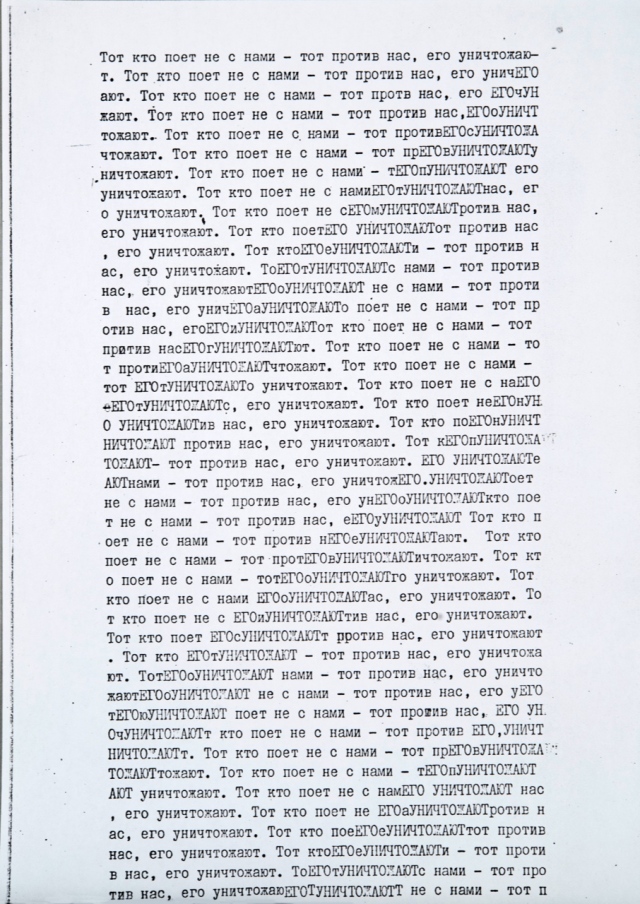
prigov_prizrak_kommunizmaI’m very excited that someone is finally having a go at translating Dmitri Prigov’s Stikhogrammy into English. Kristin Reed is a braver soul than me, and it’s wonderful to see her translations of what she terms Prigov’s Versographies published in the summer 2012 issue of Qui Parle. The selection on offer includes a couple of pieces that I discuss in A Common Strangeness. My only question on a quick look through them: why did Reed choose the translation “A shadow wanders Europe . . . the shadow of communism,” when the standard English translation of those famous lines is “A spectre is haunting Europe — the spectre of communism”?

Posted in Uncategorized | Tagged , , , , , | Leave a comment

Burnt Copies

Detail from The Crime LINKS in the Smoke, by Campbell Walker

Detail from The Crime LINKS in the Smoke, by Campbell Walker

The final post in my Jacket2 commentary on “Iterations” takes a very local turn. Like Prigov’s Little Coffins, New Zealand artist Campbell Walker’s 2012 work The Crime LINKS in the Smoke is an undead work that plays on the print book as both fetishized object and repeatable copy. The Crime comprises cut-up pages from detective novels that were burnt in the fire that destroyed Raven Books, a secondhand bookshop on Princes St in Dunedin, New Zealand. Walker’s book is a memorial both to a particular shop and to the town where it was located. Dunedin, the small city near the southern end of New Zealand where I live, is known for its penguins and sea lions but also for its crumbling Victorian grandeur. Now mainly a university town, Dunedin was once New Zealand’s largest and most prosperous city, and the energetic local cultural scene today springs partly from the spaces opened up by the slow urban decay of a city that never grew. Walker’s work links the fate of Raven Books and Dunedin to the fate of the print codex at a time when bookstores everywhere are closing their doors and e-book sales are increasing exponentially. Read more here.

Posted in Uncategorized | Tagged , , , , , , , , | Leave a comment